Friday, July 30, 2021

knowing past knowledge: tesseracts of length and breadth and height and depth.

Read this! Ephesians 3:14-21


 I got to take one single class from Dale Allison. He’s probably the world’s foremost scholar on the Gospel of Matthew, and if he heard me say that, he’d question the “probably.” But I had the opportunity, while he was still a professor at Pittsburgh Theological Seminary, to take “An Introduction to the Gospels” with him. So imagine a bunch of preschoolers surrounding Robert Frost or Mark Twain and asking him to teach them their ABC’s. It was probably a pretty maddening situation for Dr. Allison. Anyway, lacking the brilliance and incredible memory recall that he has, I can tell you that the number one main thing I took away from his class was the absolute mystery of all of this stuff we’re supposed to “know.” I always laugh at the title of my masters degree - the Master of Divinity - as if, now that I have this degree from a properly accredited university, I can now tell you how it is, how it all really and truly is. I have “mastered the divine.” But Dr. Allison had this one line that he would most emphatically and enthusiastically repeat over and over again. When he was asked a question from an anxious and well-meaning student who was squirreling away all the right answers so that they could produce them at a moment’s notice throughout their pastoral career, when asked a question from a student who was desperate for and demanding certainty, he would say, with a kind of squeak in his voice, “I don’t know! Nobody knows!” 


I mean, just imagine it. You’re in a lecture hall watching probably the most brilliant Matthew scholar pace and scribble on the chalkboard in his sagging jeans and ill-fitting blazer, the man who has read it all and is still reading it all, say I don’t know. He may not know, but, like the Socrates quote that says “The only true wisdom is knowing that you know nothing,” you start to think that he really does…know.

It’s this different kind of knowing, though. It’s a kind of knowing that we can’t really comprehend. It’s, as the author of the Letter to the Ephesians says, it’s a “knowing that surpasses knowledge.” I mean, that’s a little trippy, a little mind bending, right? But if we read this passage slowly, we have to ask, how in the world can someone know something beyond knowledge? I mean, it starts to sound like nonsense, which, by the way, is why I think we either like to write off these complicated letters attributed to Paul, or why we latch on to one verse out of context and plant megachurches and use lasers and fog machines in response to them. But there is a third option, and that’s a kind of wrestling with the passage. It’s a kind of listening and being attentive to how these words are interacting with The Word, and with the words of our everyday lives. It’s a stretching kind of practice, where we try to make our minds less like granite upon which we carve all the things we supposedly “know,” and more like rubber bands that stretch and move and adapt according to what it’s trying to hold. 


So let’s just grab a pail and a shovel and dive in to the sandbox. Let’s play a little bit. Our scripture today tells us that we can know past knowledge so we can be filled with all fullness. And our writer today kneels before God, a posture of passivity and submission, and prays that we might have the power to experience this. Kneeling for power. Knowing past knowledge that fills us with all fullness. 


The letter to the Ephesians is sort of this great summary of all of Paul’s ideas. He may or may not have actually written the letter, but the emphasis of the letter is one of describing what God has done, which is breaking down all these walls that separate and divide, and what we should do in response to this new, radical, mind-bending, spiritual physics set before us. This prayer in the third chapter is the hinge upon which these two ideas rest. And so, we can start to think about, start to play with, this idea that because God knelt for power through Jesus Christ, so can we. That because God knows beyond knowing, so can we. And because Christ dwells in our hearts, we, too, can be filled with all fullness. But to play like this, to stretch our minds like this, we need to stretch that rubber band of our minds further than we have ever done before. We need to explore our sixth sense. We’re invited to see beyond three dimensions. We’re called to know beyond knowledge.

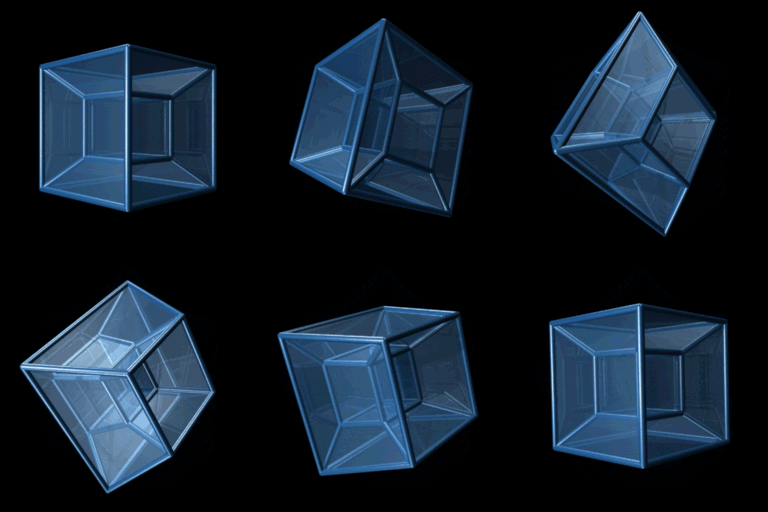
For some physicists, the fourth dimension is thought to be time. And the fifth dimension is this mathematical possibility of the “tesseract” or the “hypercube.” According to geometry folks, this hypercube is the fourth dimension, and I don’t really understand all the differences, but the point is that there’s this dimension that has been at least mathematically proven to exist, even if we don’t directly experience it. So get ready. Take a deep breath. Let’s play.

So we know the first dimension is a straight line connecting two points. Let’s call it the “breadth.” If you “square the line” you’d get a square. That’s the second dimension. This is what we can see when we draw or write or experience art. It’s flat. We’ll call that the “length.” Then the third dimension is how we all experience life - you’d “square the square” and come out with a cube - things have form and shape, roundness. It’s the difference between a sphere and a circle. Between the flat-earthers and all those explorers who didn’t fall off the face of the earth. So we’ll call that the “height.” But what if we squared that cube? What would happen then? Let’s call whatever that is the “depth." It’s super mindbendy. And people try to draw it, but nobody can quite do it justice because we simply can’t fully experience it. We are limited to our three dimensions. But just because we are limited to three dimensions doesn’t mean that a fourth or fifth or even sixth dimension isn’t there. But there’s this theory that if we could experience a tesseract, we could surpass the bounds of space and time. We could maybe even know beyond knowledge. And I think maybe this almost describes what happens when we “get it.” You know, that half a second that you have this experience and something just makes a kind of sense, or you feel the presence of the holy, or you feel like you’re connected to more than just yourself. It’s a flash in the pan where you thought maybe you heard someone calling your name, or you felt a strange comfort, or you had this sudden desire for something that you knew nothing in this world or through your meager five senses could fully fulfill. It’s a fourth dimension. It’s something new, entirely outside of your previous experience, that fills you with wonder and awe and maybe for a millisecond some level of understanding and then poof, it’s gone, like trying for the briefest of moments to comprehend a tesseract, a dimension past the three that we experience right now.  It’s the breadth and length and height and depth of God’s love for us.


I used to think that this kind of thing just didn’t happen to me. I used to think you had to be really holy, you had to sit in lotus position and fast, or stand on a pole like those stylites who stood on pillars for thirty years, or walk over hot coals or wander the desert to experience that thing that’s outside of my traditional, reasonable knowing. Or, maybe I just had to believe harder. Maybe all those who claimed to have these multi-dimensional experiences just had more faith. Or maybe they worked harder, or were luckier, or were pulled out of gym class to join some special forces unit and told the secrets of the universe while I failed, yet again, to serve the volleyball over the net. 


But now, I don’t know. Maybe it’s not so hard. Maybe it’s not as impossible as I thought. Maybe I only have to travel as far as my own heart to get the tiniest glimpses of what this might look like. Maybe there’s a little bit of tesseract in me. In you. In the fireflies we caught last night, cupping them in our hands until they lit up the whole darkness we’d formed around them, and then letting them go, back out into the night. Maybe there’s Christ, dwelling in my heart, as I’m being rooted and grounded in love. I love that our epistolarian takes us beyond the limits of our understanding, past the limits of our knowledge, outside the bounds of reason and then, also, roots us, grounds us, in love. Like a kite tethered to the ground, we are invited to fly and soar and explore and play, but at the end of the day, no matter where our travels take us, even if it is outside the bounds of space and time, we always always have love to come back to.


I guess that’s why I’m not at all impressed by these billionaires flying themselves up into outer space. It’s been done before. It’s old news. Especially when these guys have the resources to go where no human has ever gone before and take us with them - to a world where everyone has enough food to eat, or a world where we slow down the destruction of our planet, or a world where people get all the medical care they need. I don’t know. I shouldn’t judge. But it seems to me that these guys are suffering from a lack of imagination here. They have hundreds of billions of dollars and still they are thinking in only three dimensions. They’re refusing to know beyond their knowledge in order to see what’s beyond their power, in order to be filled with the fullness, and finally be full, so they realize that they don’t need anything else. So they know that they, too, are rooted and grounded in love. 


But of course, when I point one finger at someone else, there are three fingers pointing back at me. And I think about all the ways that I have reduced God and reduced this life to reason and comprehension and test scores and only three dimensions. I’ve written my story in granite, instead of explored my life’s possibilities with the elasticity of a rubber band. I’ve denied the Christ that is in my heart, I’ve refused to make a home for him, I’ve wanted to cut myself off from God’s rooting and grounding love. I’ve had to know all the things because I was too afraid to admit that “I don’t know. Nobody knows.”


I just “know” or think I know, that when I slow down, when I have a sense of awe, when I try to experience something in the fullness of what it is, I start to experience that thing in new dimensions. The two pine trees I pass by on my walk start to grow a little greener. The conversation with my son about Fortnite starts to make a little bit more sense. I start to wonder about the the homeless guy flying a cardboard sign on the side of the road, asking for money. I start to wonder about his story. I start to see him in more dimensions. I’m curious about the fear in the eyes of the white supremacist, and I can see new ways that maybe I can connect with the person on the other side of the political aisle. When we open ourselves to experiencing these new dimensions, this knowing beyond knowledge, we can start to get creative. We can see possibilities where before there were none. It’s the incarnation. Seeing the world beyond the limits of our very tiny, very limiting experience. We can stretch our minds to new encounters of hope and joy and connection and mutuality. We can understand the other, maybe just for half a second, but for that half-second it’s real and true and we are filled with the fullness of Christ’s love. That is what God is doing through Christ - expanding the limits of what it means to be God so as to fully unite with us. When we can be open to more dimensions, go beyond the boundaries we set up for ourselves, we can experience that “power that is already at work within us and is able to accomplish abundantly far more than all we can ask or imagine.”


Thanks be to God.


Tuesday, July 6, 2021

For Grandma Punky.

Photo Credit: Karen Smith


2 Corinthians 12:1-13

...My power is made perfect in weakness...

 Yesterday, I said a silent prayer. It wasn’t to God. Not really. It was to Dan’s Grandma Punky. She turned 100 years old this past March. And yesterday we got news that she’s not doing too great. She has a hospice nurse. She’s on pain meds. She fell the other day. And she’s been sick to her stomach for a few days now. On her 100th COVID Zoom birthday celebration, her whole family gathered together, through the magic of modern technology, to wish her a happy birthday. I asked her if she had any words of wisdom for us now that she’s 100. And with her no-nonsense, humorous, anti-sentimental perspective that she has had at least ever since I have known her she’d said, “Yes. Don’t live this long! It’s exhausting!” We all laughed that awkward laugh that you laugh when you hear something that is all the things: hard and true and funny and heartbreaking. She’s ready. She misses her husband terribly. It’s time. I think, maybe. Or, at least, it’s time as long as she gets to make the choice. So I said a little prayer, hoping that it would travel the 2,000 mile distance between us. “Hey Grandma. It’s just Jenn, your somewhat estranged granddaughter-in-law. You’re probably really angry at me still, and I don’t blame you. But maybe you can still know that I love you, and if it means anything to you at all, I want to tell you that it’s ok, you can go now. We are gonna be ok. Dan and I are gonna be ok. 

Of course. You don’t need my permission. You’ve always done whatever you’ve wanted - in that good sort of self-assured-but-not-abusive sort of way. And I love you for it. So whenever you choose to let go, I will love you still. I just wanted to say that to you.”

I mean, who knows. Grandma Punky may still outlive us all. She’s always been so strong. So self-assured. So independent. The fullest embodiment of the matriarch of the family. I wonder what she is thinking now, as she looks back on all the little and big deaths she has endured that have brought her to this moment, as she looks back on all her blessings and the sheer luck that she’s been given. I have only known her for 1/5 of her life, but from what little I know about her, she doesn’t need my permission to do anything. So I think I was probably giving myself permission in that little prayer. “God, it is going to bring me to my knees to live in a world without Grandma Punky. So here I am. On my knees.” I’m too weak to survive her absence, but I’m going to lean in to that weakness, because I love her, because she deserves to make her own choices and not stick around just because we’re all so scared and sad and broken.


So I am going to boast about that. I am going to boast that I know a woman who had five kids, and a husband who fought in the war. And those five kids are as different from each other as five people can be. And yet they love. They agree to disagree. They agree to eat at the same table without mentioning religion or politics. I’m going to boast that she hiked the Grand Canyon in her late seventies, simply praying to God, “You pick ‘em up, and I’ll put ‘em down.” I’m going to boast that she took us out into the desert in her Geo Tracker to search for turquoise, and she was there the first time I’d ever eaten lobster tail. I’m going to boast that she is still reading new books even as she turned a hundred years old. I'm going to boast about her incredible memory and how she looks back on her life with gratitude. I am going to boast about her almost seventy year long marriage. About how, when Stew died, after a long battle with Alzheimer’s, she’d said she felt like she’d gotten him back somehow. About how, when my own marriage was falling apart, I looked to her example, how I still wanted what she had. I’m going to boast that I could talk to her about Madeleine L’Engle and grace-filled theology and backyard roses and climbing Mount Baldy. I’m going to boast that she liked my sermons. That she encouraged me. She called me “dear.” I’m going to boast that even though I can’t say that I knew her all that well, I can say that I knew her. I’m going to boast that her death, whenever it happens, is going to bring me to my knees.


How lucky am I that I got to marry into a family that has a Grandma Punky? 


I’m going to boast that because I could always see a little bit of myself in her, and I could always see a little bit of Dan in Stew, that somehow, because they’d made it so long, I could look to them and believe that marriage was true and good and possible, even after heartbreak and brokenness and betrayal. I could look to Punky and Stew and say, “That’s what I want. I’m not ready to give that up yet.” 


I look to her, maybe a little bit like Paul looks to this unknown person who was “caught up to the third heaven” and was told a secret that they can never share, but a secret that is accessible to everyone. I look to her. I’ll boast about her. Because I think she knows the secret. She knows she can’t tell me the secret, but she gives me little hints every day that she lives her life.


I may never know the secret. But I get to know someone who does. And I’m not ashamed to boast about that. 


I’m going to boast that I need Grandma Punky in this world. And then, when she is gone, I’m going to boast about how her presence forever changed me, and about how her absence is going to leave a wound that I will never recover from. I need Grandma Punky. In that I will boast. I will lose Grandma Punky. And in that, too, I will boast.


This needing of each other is such a weakness, isn’t it? We especially don’t like to think about it on Independence Day. But on this our nation’s Independence Day, Paul is proudly proclaiming that he is far from independent. In fact, he is passionately pleading with the Corinthians that they need him, and that he needs them. He can’t do this alone. He can’t spread the good news of Jesus Christ all by himself. He can’t be himself without them. They cannot be themselves, without him. Call it codependency or disordered attachment, but none of us can be who God made us to be without the fullness and freedom of others being who God made them to be. This is a communal effort, this living life thing. The Corinthians have broken his heart, again and again, over and over again, and still, he fights for them, still, he needs them. He is calling them into their better selves. He knows that they are calling him into his better self. But he also knows that we call each other into our better selves, not by boasting about all the things we can do well, or all the things we know, or all the things we’ve accomplished, but by sharing all those vulnerable spaces, places where our hearts have been broken, places where our stories intersect, places where we need each other. Places where we’re not enough on our own. 


Unlike the so called “super-apostles” who have so much to offer and have caught the imaginations and the purse strings of the crowds, who have all the answers and all the resources and all the other worldly visions and all the community development skills and the perfect antiracist answers, Paul, even though he, too, probably has all of those things, and the certificates and diplomas and graduation tassels to go with it, Paul is going to boast in his weakness, in those empty places, in those spaces of need, in those questions and hurts and beatings and little crucifixions that life has brought him. This is no exchange economy where he gives and they get. He brings them his nothing.  He boasts in this mysterious “thorn in his side” that has perplexed scholars for two millennia. He makes himself a “fool” for the Corinthians. Because he loves them. Because he needs them. Because he will fall to his knees and be forever broken when he is separated from them. Does he boast in his loneliness? Does he boast in his disagreements with Peter? Does he boast that he had it all wrong for so long and it took him going blind to finally figure it out? Even now, even today, as he himself is caught up in his own third heaven, does he boast that maybe he didn’t get everything right in all of his letters, or that maybe his words have been misconstrued and misinterpreted? That maybe people have twisted his words and that has hurt people? But also that these broken words, through the power of God, have put some people back together again. Does he boast that he tried, he showed up, and because of that, because he’s “just" a human, in some ways, he failed, but, because of Christ, that’s exactly where his power is? 


He failed just as Jesus failed. According to the powers and principalities that rule our world Jesus was an absolute failure. An “L7 weenie.” He didn’t lead an army. He didn’t overturn the government. He didn’t give everyone healthcare and a two car garage. He didn’t ride his horse in the middle of the night to warn that the British are coming. He got himself killed. Killed on a cross. Horrific. Embarrassing. Shameful. Even his best friends betray him. Even those whom he has loved with all of his heart abandon him when he needs them most. He gets shoved into a borrowed tomb while peasant women weep at its door. And Paul, and Peter, and the other disciples, and the women, and the early followers of Christ, and all of us who profess that Jesus Christ is Lord, will follow in his footsteps. Not as perfectly. Not as dramatically. Not with such holiness. But still. In our weakness. In our brokenness. Just like Christ’s.


But this is power, Paul says. This is a different kind of power - the power of Christ dwelling in him. The power of weakness. The power of need. The power of what it means to love something so much that you would sacrifice anything, you would lift cars, race into burning buildings, hand over both of your kidneys and stand in front of bullets just so that this other can be, just so that this other can survive. 


It’s the kind of power that has you weeping in a crappy apartment, calling out to God because you have nothing left, and you can’t bear to lose even that. It’s the power of the pleading mom at the hospital bedside. It’s the power of the seed that’s dying so something new can grow. It’s the power of those pinecones that need the heat of a forest fire in order to open up and let their seeds go. It’s the power of empty hands and open hearts. It’s the power of facing that you’ve really screwed up. It’s the power that comes from loving someone so much and so hard that you will never ever fully heal when they have to leave you. It’s the power of walking with a limp. It’s a blessing, this weakness. It’s power.


So, Grandma Punky, this sermon is about you, sure. But it’s also about all of us. It’s about how we will love and love and love and love until it kills us. And that, my friends, is the power of Christ. 


So when you are mourning someone you love. When you are regretting your decision. When you are beating yourself up for those choices you’ve made. When you are terrified about your next steps. Recognize that that is the exact place where you need Christ. Where Christ needs you. The exact place where Christ has come and dwelt among us, full of grace and truth. God tells all of us, in all the little and big concrete ways of our lives, “My grace is sufficient for you, for power is made perfect in weakness.” So we will boast all the more gladly in our weaknesses, in our need, in our relationships that make us so very vulnerable, so that the power of Christ may dwell in us. Therefore, we are content with weaknesses, with insults, insults, hardships, persecutions, calamities, deaths, separations, and all those places where we gave our hearts and they got broken, all for the sake of Christ; for whenever we are weak, then we are strong.


I love you, Grandma Punky. Whenever it’s your turn, whenever you’re ready, I’m going to be strong enough to fall apart.


Thanks be to God.